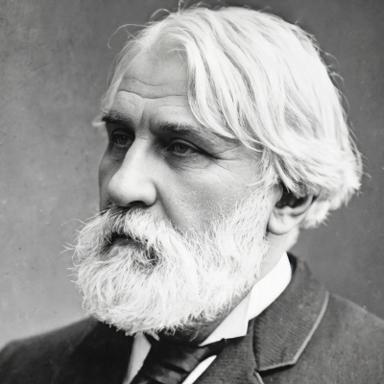
Ivan Turgenev
- Born
- 1818 · Oryol, Russian Empire
- Died
- 1883 · Bougival, France
- Nationality
- Russian
- Forms
- Sketches (A Sportsman's Sketches), novels, novellas, short stories, plays
Ivan Sergeyevich Turgenev was born in 1818 in Oryol, in the heartland of Russia, on a large estate where the birch trees stood pale against the sky and the serfs worked the fields from dawn until dark. His mother was wealthy, intelligent, and cruel — she beat her servants and her children with equal conviction. His father, a handsome cavalry officer, was distant and died young. From this unhappy house, something tender nevertheless emerged. The boy wandered the woods and meadows, watched the peasants at their work, listened to their songs, and learned to feel things deeply without knowing yet what to do with such feeling. He studied in Moscow, then St. Petersburg, then Berlin, where German philosophy taught him to think clearly about what his Russian heart already knew.
He returned home and began to write. His first great work, A Sportsman’s Sketches, described the lives of peasants and landowners he had known in the countryside — their dignity, their suffering, their small, stubborn joys. The book was so gentle and so truthful that it helped turn educated Russians against serfdom. Tsar Alexander II himself said it influenced his decision to free the serfs. Then came the novels — Rudin, A Nest of the Gentry, On the Eve, Fathers and Sons, Smoke, Virgin Soil — each one exploring the restless young generation and the old world it could neither save nor leave behind. He wrote about love the way one remembers a landscape seen from a departing train: beautiful, already receding, never quite possessed.
Turgenev spent much of his adult life abroad, especially in France, following the singer Pauline Viardot, whom he loved for forty years with a devotion that was patient, hopeless, and strangely happy. He became the first Russian writer widely celebrated in Europe, a friend to Flaubert, to George Sand, to Henry James. At home, radicals called him too cautious and conservatives called him too liberal, which perhaps meant he had told the truth. He died in 1883 near Paris. He had asked to be buried in Russia, and so he was — returned at last to the country he had loved from a distance, the way he loved most things: completely, and from just a little too far away.
No published works by this author yet.