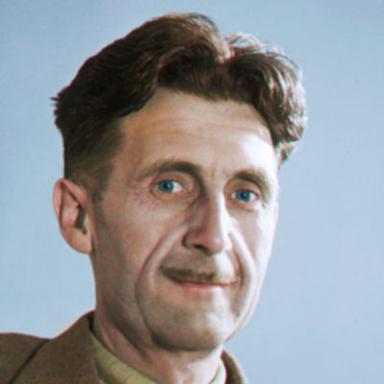
George Orwell
- Born
- 1903 · Motihari, British India
- Died
- 1950 · London, England
- Nationality
- British
- Forms
- Novels and essays, journalism, memoirs
George Orwell was born Eric Arthur Blair in 1903 in Motihari, India, where his father worked for the British colonial government. His family was not rich. He called them “lower-upper-middle class” — people who kept up appearances but had very little money. He won a scholarship to Eton, one of England’s most famous schools, and there he began to notice things. He noticed who had power and who did not. He noticed the lies people told to keep things the way they were. After school, instead of going to university, he joined the Indian Imperial Police in Burma. He was twenty years old, carrying a rifle, and representing an empire he had already begun to hate. He quit after five years and came back to England with a need to write and a guilty conscience.
He went to Paris and then to London. He lived among the poor — not to study them, but to understand what poverty actually felt like. He washed dishes in hotel kitchens. He slept in shelters for homeless people. He wrote about it plainly, in clear sentences, because he believed that unclear writing was almost always dishonest writing. His first book, Down and Out in Paris and London, came from these experiences. Then came The Road to Wigan Pier, about working-class life in northern England, and Homage to Catalonia, about fighting in the Spanish Civil War, where he was shot through the throat by a sniper and nearly died. Spain changed him. He saw how political parties lied about what was happening, even on their own side. He never trusted political language again.
He wrote his two most famous books while he was already very ill with tuberculosis. Animal Farm is a short, sharp story about a revolution that goes wrong. Nineteen Eighty-Four is about a world where the government controls not just what people do, but what they think. Both books came from the same idea: that power corrupts, and that language is the first tool the powerful use to hide the truth. He believed the writer’s job was simple — to say what was true, as clearly as possible, even when it was uncomfortable. He died in London in January 1950. He was forty-six. The words he cared about most — plain words, honest words, words that could not be twisted — are still the ones that matter.
No published works by this author yet.