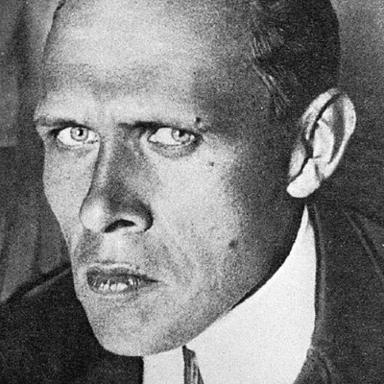
Daniil Kharms
- Born
- 1905 · Saint Petersburg, Russian Empire
- Died
- 1942 · Leningrad, Soviet Union
- Nationality
- Russian
- Forms
- Absurdist miniatures, poetry, plays, children's stories
Daniil Kharms was born in St. Petersburg in 1905. His real name was Daniil Yuvachev, but he did not want it. He chose “Kharms” instead — a word that sounds like “harm” in English and “charm” in English, both at the same time, which is exactly right. His father had been a revolutionary and then a religious writer and then a man who lived quietly and did not cause trouble. Kharms himself was tall, wore strange clothes, and carried a pipe he did not always smoke. He liked the number 7. He liked standing on his head. He liked things that made no sense, because he suspected that things that made sense were lying.
In the late 1920s he started a group called OBERIU — the Association for Real Art — which performed plays where objects fell from the sky and people said words that did not belong to them. The audience was confused, which was the correct reaction. He wrote poems that broke apart like dropped plates. He wrote very short stories — some only a few sentences long — collected later under the title Incidents, in which a man falls out of a window, then another man falls out of a window, then another, until it becomes boring and the narrator stops watching. An old woman falls out of a window too. A man goes out to buy something and forgets what, and never comes home. These things happen, one after the other, and there is nothing to be done about them. The Soviet government did not publish these stories. They published his children’s poems instead — funny, clever poems about adventures and animals — which appeared in the magazines Yozh and Chizh and which children loved very much, not knowing that the man who wrote them sometimes had nothing to eat.
He was arrested in 1931 and sent away. He came back. He was arrested again in 1941, during the war, accused of spreading defeatist ideas, which in those days meant saying true things at the wrong moment. He died in February 1942, in a psychiatric prison hospital in Leningrad, during the siege, of starvation — which was the same thing that was happening to everyone in the city, except that Kharms was in a cell. He was thirty-six years old. His manuscripts survived in a suitcase, kept by a friend. They were published decades later, and readers discovered that this strange, hungry man in his odd hat had written some of the funniest and most terrifying short works of the twentieth century — stories in which the ordinary world comes apart at the seams, calmly, politely, and for no reason at all.
No published works by this author yet.